We analysed the 1,000 most frequent word components in INPI opposition decisions, representing more than 45,000 occurrences, and the way the INPI qualifies each of them. We then matched these qualifications against the outcome of nearly 4,400 comparisons of signs sharing the same words.
Here is what the data shows, and what it changes for your practice and your clients.
Finding no. 1: when the INPI rules, it most often finds the component “weak”
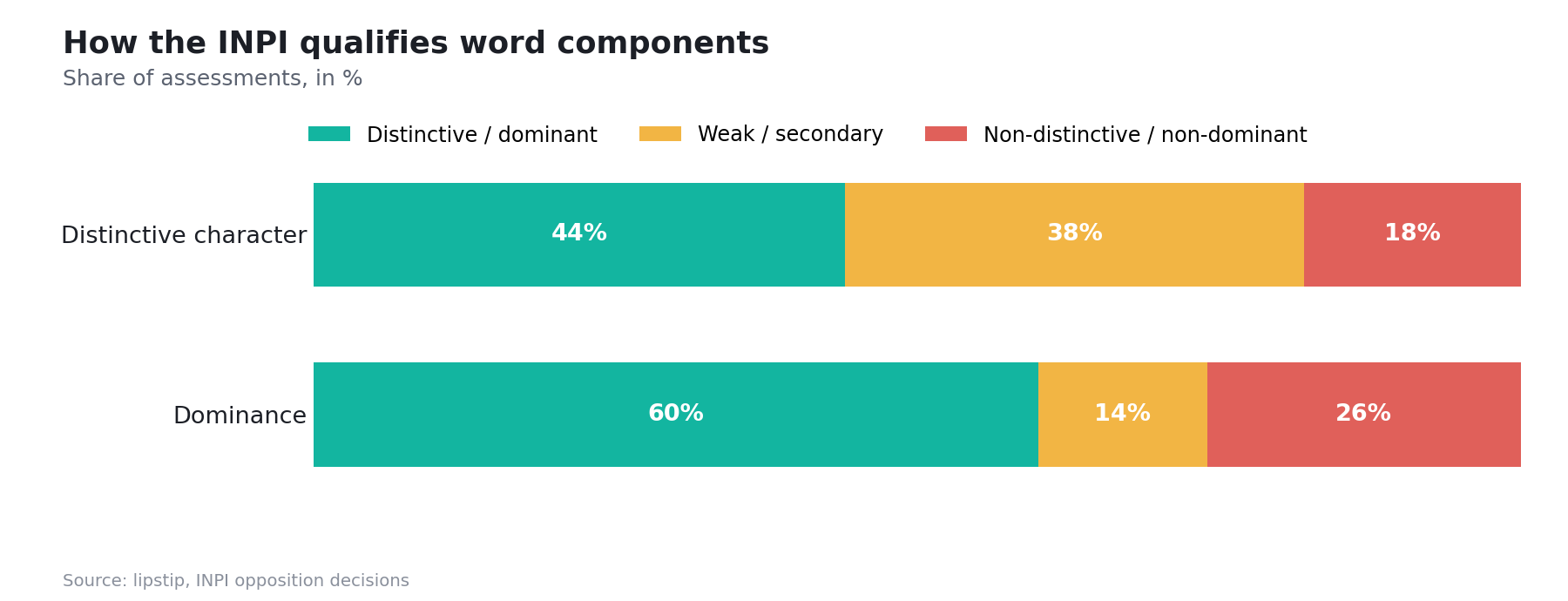
When the INPI assesses the distinctive character of a word component, it finds it distinctive in only 44% of cases. In 38% of cases, it qualifies it as weakly distinctive, and in 18% as devoid of distinctive character. More than one time in two, the component under review is therefore considered weakly distinctive.
Conversely, some components are almost never discussed. The French articles DE, LA and LE each appear in 800 to 1,000 decisions, yet their distinctive character is examined in only 2 to 4% of them: they are “neutral” by default.
Components found weakly distinctive or non-distinctive fall into three clear families:
- Geographical and terroir terms: PARIS (97% weak or non-distinctive findings), FRANCE (98%), CHATEAU (98%), DOMAINE (97%), CHAMPAGNE (98%).
- Generic business terms: SERVICES, GROUP, GROUPE, INTERNATIONAL, CONSULTING, FINANCE, IMMOBILIER, found weak in 100% of cases, and CONSEIL in 99%.
- Positioning or format terms: BIO (99%), .COM (99%), PRO (98%), MAISON (97%), COLLECTION (98%).
At the other end of the spectrum, ZARA, EDEN, ESPRIT, PASSEPORT, NEXT or PLANETE are found weak in only 0 to 14% of cases. What they have in common: a semantic content unrelated to the goods and services concerned.
Finding no. 2: distinctiveness is assessed in relation to the goods or services, not the word itself
EASY illustrates the point better than any other component. It is found distinctive in 52% of cases and weak in 48%. This split is no inconsistency. For software or services presented as easy to use, the term is laudatory and part of everyday vocabulary; for other goods, it becomes a fanciful term again.
PLANETE follows the opposite path. Present in classes 35, 41, 38 and 16, it is still found distinctive in 86% of cases, because it evokes none of those services.
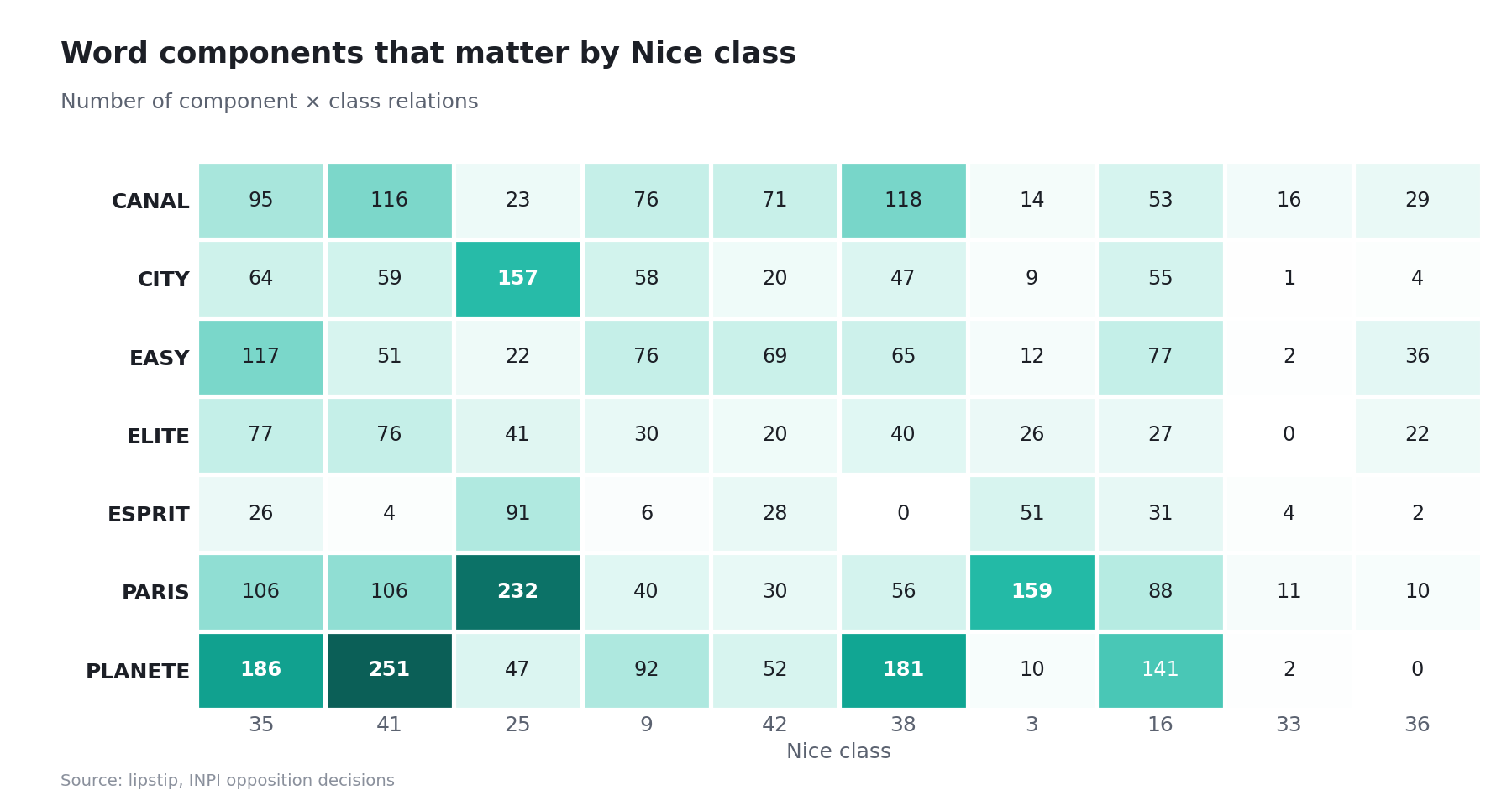
A word therefore has no distinctiveness in itself. It has distinctiveness for given goods or services, and that is the level at which the analysis must be carried out.
Finding no. 3: a weakly distinctive or non-distinctive component is almost never dominant
Distinctiveness and dominance go hand in hand. Across the 170 most frequently qualified components, the correlation between weakness and lack of dominance reaches 0.75 (Spearman coefficient, where 1 would mean a perfect match).
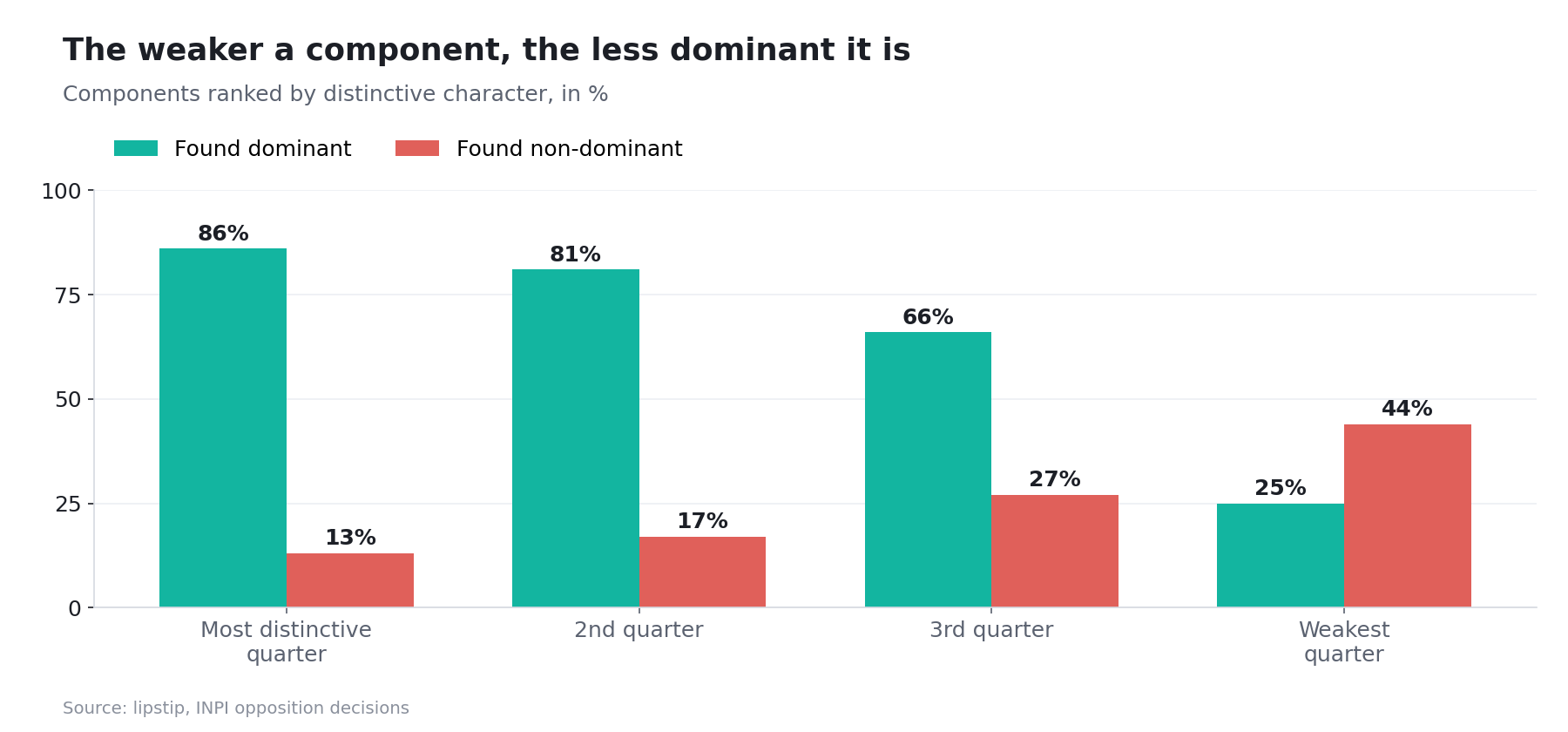
The INPI's reasoning shows through: when it finds a component weak, it most often infers that this component cannot dominate the overall impression or be the one remembered by the public, and shifts the analysis to the rest of the sign.
Dominance nonetheless remains relative to the sign itself. CITY is found distinctive in 83% of cases, yet non-dominant in 34%: in “X CITY”, another, stronger component often takes centre stage.
Finding no. 4: dominance weighs more heavily than distinctiveness on the outcome
When two marks share the same word, the way the INPI usually qualifies that word is reflected in the outcome.
| Shared word | Infringement found |
|---|---|
| Most distinctive quarter of words | 83% |
| Weakest quarter of words | 64% |
| Quarter of words most often found dominant | 92% |
| Quarter of words most often found non-dominant | 64% |
Dominance opens a 28-point gap, distinctiveness a 19-point gap. The correlations confirm it: 0.77 with dominance, 0.53 with distinctiveness.
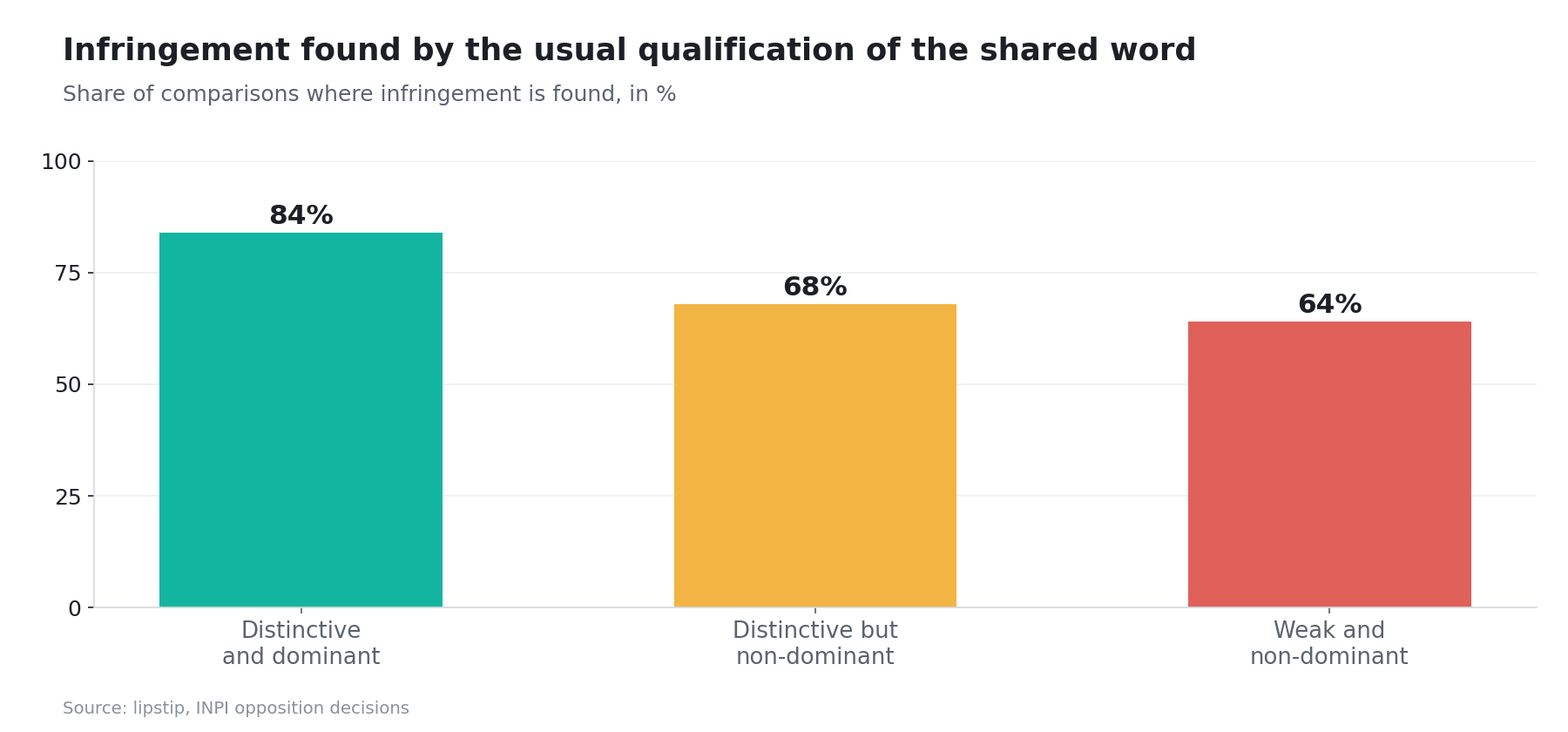
Crossing the two qualifications is even more telling. A distinctive and dominant word leads to infringement being found in 84% of cases. A distinctive word that is often found non-dominant does so in only 68% of cases, almost as low as a weak and non-dominant word (64%).
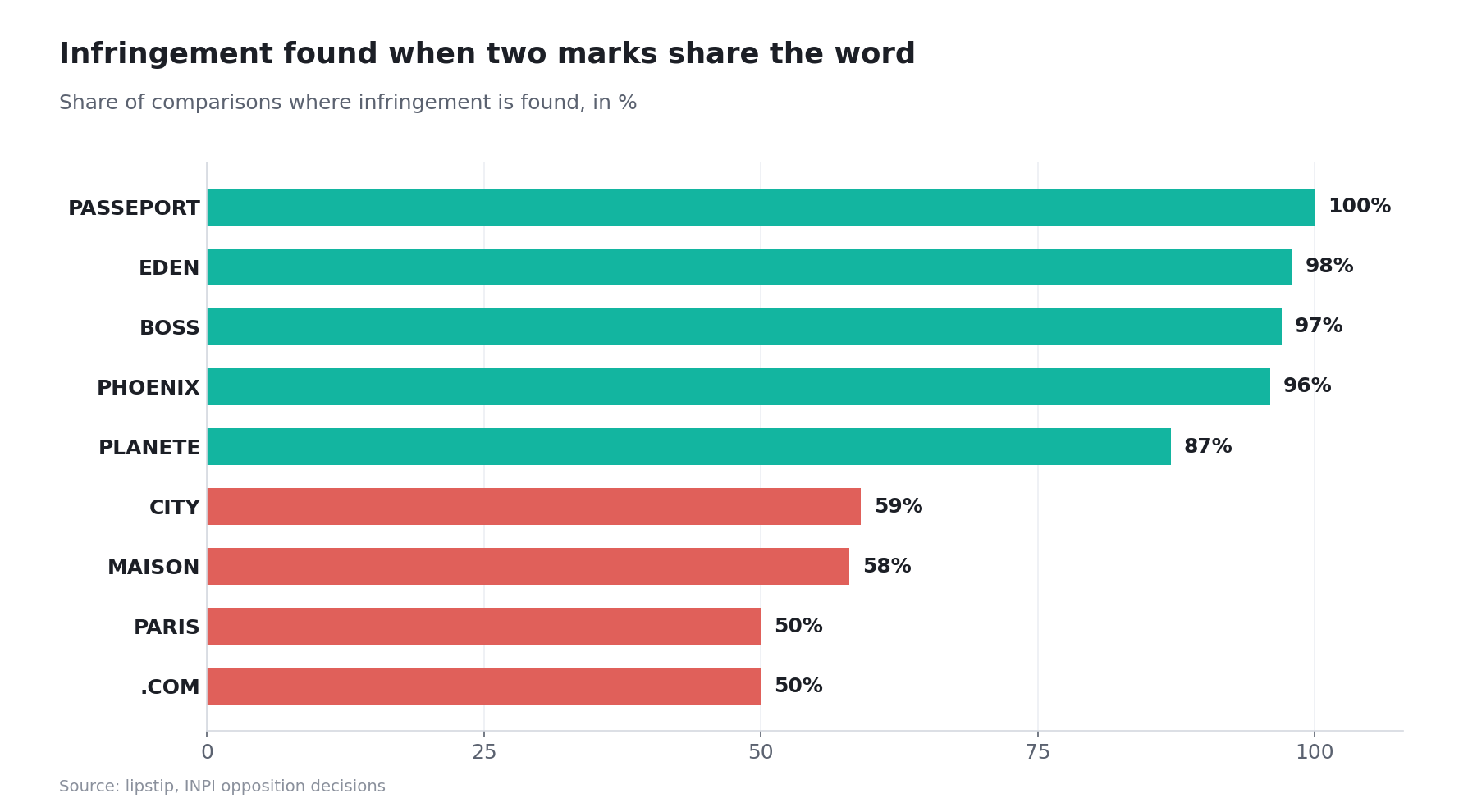
Concrete examples draw the same line. Sharing PARIS or .COM leads to infringement being found in 50% of cases, MAISON in 58%, CITY in 59%. Sharing PASSEPORT does so in 100% of cases, EDEN in 98%, BOSS in 97%, PLANETE in 87%.
Distinctiveness is a precondition; dominance is what turns it into a likelihood of confusion.
What this changes in practice
- Before filing: avoid building a mark on a geographical, terroir or generic term, and choose a component that is arbitrary in relation to the goods concerned. Then give it pride of place in the sign: a strong component relegated to the background loses most of its protection.
- When opposing: do not merely show that the component taken is distinctive. You must establish that it dominates the overall impression, in the earlier mark as in the contested sign.
- When responding to an opposition: challenge the qualification of the shared component for the goods at issue. If it is weak for those goods, it cannot be dominant, and the analysis shifts to the components that set the signs apart.
This is exactly what lipstip enables: retrieving in seconds how the INPI has qualified a given component, for given goods, with the source decisions to back it up. Where a manual search would take hours, you get a statistical overview and the relevant precedents, ready to cite.
Methodology: analysis of the 1,000 most frequent word components in opposition decisions published by the INPI, and of the qualifications retained in the reasoning (distinctive, weakly distinctive, customary or descriptive, non-distinctive; dominant, secondary or weakly dominant, non-dominant). A single component may be qualified several times within one decision. The link with the outcome covers comparisons of signs sharing the same word, for the 105 components with sufficient volumes, i.e. 4,396 comparisons. It establishes a trend, not a decision-by-decision causal relationship. Correlations measured with Spearman's coefficient.